Scientists have extracted and analyzed DNA from 216 canid remains, including 181 from Paleolithic and Mesolithic Europe. The oldest data that they recovered are from a 14,200-year-old dog from the Kesslerloch site in Switzerland. Their results suggest that domesticated dogs (Canis lupus familiaris) predate farming and share deep ancestry with wolves (Canis lupus) from Eurasia, challenging ideas about where and how domestication began.

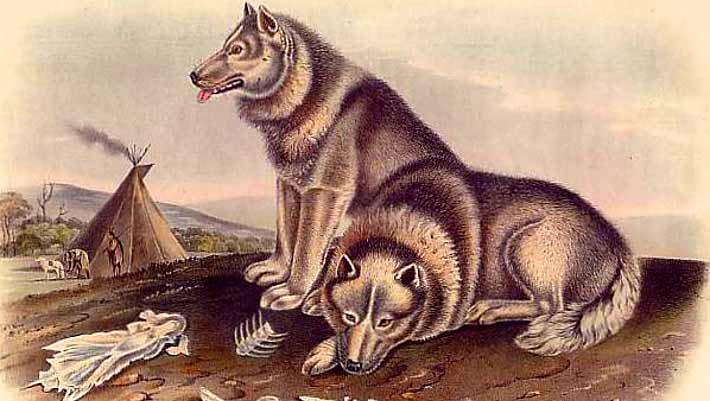
Bergström et al. found that dogs were domesticated more than 14,000 years ago and that dogs living in pre-agricultural Europe contributed substantially to the genetics of dogs living after agriculture and in the present day. Illustration by John James Audubon & John Bachman.
Dogs were domesticated from gray wolves toward the end of the latest Ice Age, becoming the first animals to form a domestic partnership with humans.
Where this process took place, and which human group or groups were involved, remains uncertain.
The earliest known canid remains displaying probable dog-like morphology have been found in Europe, dating to roughly 14,000 to 17,000 years ago.
“Dogs were the only domesticated animal to predate farming, so their evolution can help us understand how a big shift in lifestyle shaped our own history,” said Francis Crick Institute’s Dr. Pontus Skoglund, senior author of the study.
“It’s fascinating that dogs living before the era of agriculture contributed substantially to the genetics of farming and present-day European dogs.”
“Dogs were clearly important to our ancestors, as the first farmers seem to have adopted previous hunter-gatherer dogs into their groups as they moved into Europe.”
In the study, the authors analyzed DNA from 216 canid remains, including 181 samples predating the Neolithic period (before approx. 10,000 years ago), before the invention of farming.
These samples came from sites across Europe and its vicinity, including Switzerland, Germany, France, Belgium, the Netherlands, Türkiye, Sweden, Denmark and Scotland.
The researchers used a technique called ‘hybridization capture’ to boost the amount of usable DNA, designing probes to ‘fish out’ canid DNA from the large amounts of DNA from microbes like bacteria that tend to contaminate very old remains.
The scientists first categorized the samples into dogs and wolves by working out how similar each sample is to a present-day dog.
Identification as dog or wolf was possible for a remarkable 141 out of 216 remains, with some surprises.
A 13,700-year-old canid from Belgium, previously thought to be a dog due to its small size and traces of human modification, was identified as a wolf, demonstrating that genetic data is important to confirm conclusions based on the appearance of remains.
The authors also confirmed that a previously proposed dog from the Kesslerloch cave in Switzerland was genetically a dog.
At 14,200 years old, this dog is the oldest in this study and one of the oldest ever recorded.
Previous research suggested that dogs derive ancestry from two distinct wolf sources, one from eastern Eurasia and one from western Eurasia.
Using a statistical model, the researchers showed that all the early European dogs in this study can trace their origins to the eastern wolf source, with some showing small amounts of ancestry from the western wolf source.
This new evidence suggests that European wolves didn’t contribute detectably to dog evolution, and that early European dogs weren’t domesticated independently from dogs in Asia, as both share the same ancestry profile.
The Kesslerloch dog was genetically more similar to European dogs than to Asian dogs, suggesting that dogs were domesticated well before 14,200 years ago, to give time for European and Asian dogs to become genetically different by this time.
The spread of farming into Europe was accompanied by a large-scale migration of people from Southwest Asia in the Neolithic period.
By modeling the ancestry of European dogs after the arrival of Neolithic farmers, the team showed that the dog genetic changes largely mirrored the changes in human genetics, but to a much smaller degree.
This suggests that dogs from local hunter-gatherer groups already living in Europe contributed substantially to the genetics of dog populations living with Neolithic farmers.
And genetic analyses of modern European dogs show they are still largely similar to these Neolithic dogs, implying that most common European dog breeds might trace about half of their ancestry to dogs that lived in Europe before farming.
“Without using these advanced genetic tools, we wouldn’t be able to confidently distinguish dogs from wolves based on skeletal evidence alone,” said University of East Anglia’s Dr. Anders Bergström, first author of the study.
“We also wouldn’t have been able to put together such a comprehensive view of their evolution.”
“As the Kesslerloch dog, at 14,200 years old, was already more similar to later dogs in Europe than those in Asia, dogs must have been domesticated well before this point, giving time for these genetic differences to emerge.”
“Yet, many questions remain: we’re still researching where and how dogs spread across Europe after likely domestication somewhere in Asia.”
“Each piece of evidence is a step forward in this journey.”
The results were published in the journal Nature.
_____
A. Bergström et al. 2026. Genomic history of early dogs in Europe. Nature 651, 986-994; doi: 10.1038/s41586-026-10112-7
About The Author