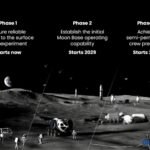

NASA has made a big shift in its space strategy. Instead of building a space station around the Moon, the agency now plans to create a permanent base on the Moon’s surface. At the same time, it is preparing a nuclear-powered spacecraft mission to Mars. The decision marks a major change in how humans could live and work beyond Earth in the coming years. Why NASA is changing its plan NASA Administrator Jared Isaacman, appointed by Donald Trump in December, announced the update during a meeting in Washington, DC. The move is part of a broader rethink of NASA’s long-term Moon-to-Mars strategy. One key reason is global competition. The United States wants to return astronauts to the Moon before China lands its crew there around 2030. A $20 Billion moon base plan NASA will spend about $20 billion over the next seven years to build infrastructure on the Moon’s surface. This base is meant to support long-term human presence, not just short visits. Before astronauts arrive, robotic missions will: These steps will make future missions safer and more regular. Nuclear spacecraft mission to mars NASA also revealed plans for a spacecraft called Space Reactor 1 Freedom. It is expected to launch before 2028 and test nuclear electric propulsion in deep space. The spacecraft will carry helicopters to Mars, similar to Ingenuity, which traveled with the Perseverance rover and became the first aircraft to fly on another planet in 2021. This mission will help turn nuclear propulsion from an experiment into a working space technology. What happened to the Lunar Gateway? NASA has paused work on the planned lunar-orbit station Lunar Gateway. Instead, parts of it may now be used for the Moon base. This change creates uncertainty for partners such as European Space Agency, as well as Japan and Canada, which were building components for the station. According to Isaacman, the focus is now on building systems that support continuous operations on the Moon’s surface. A new phase of the Artemis programme The changes reshape the future of the Artemis programme, launched in 2017 as the next step after the historic Apollo programme. With plans for a Moon base and nuclear missions to Mars, NASA is moving from short visits in space to long-term human exploration beyond Earth.
The post NASA to spend $20 billion on Moon base:Space agency unveiled roadmap to test ‘nuclear spacecraft’ and deploy Mars helicopters appeared first on Tri-Cities India.
About The Author