
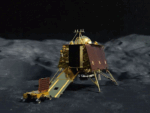

Nearly six years after its launch, ISRO’s Chandrayaan-2 mission has identified possible signs of subsurface ice near the Moon’s south pole. Scientists from Ahmedabad-based Physical Research Laboratory (PRL), using data from Chandrayaan-2’s Dual Frequency Synthetic Aperture Radar (DFSAR), have detected radar signatures consistent with buried ice beneath several permanently shadowed lunar craters. The findings, announced by the Indian Space Research Organisation (ISRO), could strengthen plans for long-term lunar exploration and in-situ resource utilisation. Study examines ultra-cold ‘doubly shadowed craters’ The research focused on ‘doubly shadowed craters’, impact craters located within permanently shadowed regions (PSRs) of the Moon. These regions remain continuously shielded from sunlight and thermal radiation, causing temperatures to fall to nearly 25 Kelvin. Scientists consider them among the coldest known locations in the Solar System, making them ideal environments for preserving water ice over geological timescales. Using advanced radar polarimetric analysis, researchers identified signatures indicating the possible presence of subsurface ice beneath four doubly shadowed craters in the lunar south polar region. Radar data strengthens buried ice theory According to ISRO, the study proposes a refined radar-based method for identifying buried lunar ice. “The study proposes a refined radar-based criterion for identifying subsurface ice, where Circular Polarisation Ratio (CPR) values greater than 1, together with Degree of Polarisation (DOP) values lower than 0.13, indicate volumetric scattering potentially associated with subsurface ice,” the space agency said. DOP is a radar polarimetric parameter that measures how much of the reflected radar signal retains its original polarisation after interacting with surface or subsurface material. Scientists said the method helps distinguish genuine ice signatures from radar reflections caused by rough rocky terrain. Faustini crater shows strongest evidence Among the craters analysed, researchers found particularly strong evidence of subsurface ice inside a 1.1-km-wide crater located within the larger Faustini crater near the lunar south pole. Scientists said the crater displayed a distinctive ‘lobate-rim morphology’, a flow-like structural pattern suggesting the original impact may have penetrated an ice-rich subsurface layer. Researchers said the crater’s morphological features, combined with the radar observations, make it one of the strongest candidates yet for buried lunar ice deposits. Why the discovery matters Scientists believe the findings could play a major role in shaping future lunar missions, particularly those aimed at establishing a sustained human presence on the Moon. Water ice is considered one of the Moon’s most valuable potential resources because it can potentially be converted into drinking water, breathable oxygen, and even rocket fuel for deep-space missions. The latest discovery adds to a growing body of evidence from Chandrayaan-2 suggesting that the Moon’s polar regions may contain substantial reserves of water ice beneath the surface. The findings provide important new insights into the distribution of lunar polar volatiles and have significant implications for future lunar exploration missions, including the identification of potential ice-bearing regions for future landing and in-situ resource utilization (ISRU) activities. Earlier studies using Chandrayaan-2 data had already identified signatures of water molecules and hydroxyl across parts of the lunar surface. More recent datasets from the orbiter have also helped scientists create high-resolution polar maps to identify potential ice-bearing regions. Chandrayaan-2 orbiter continues operations Chandrayaan-2 was launched in July 2019. While communication with the Vikram lander was lost during its attempted lunar touchdown on September 7 that year, the orbiter has remained operational and continues to function successfully. The DFSAR instrument onboard Chandrayaan-2 is regarded as a major technological achievement, becoming the first fully polarimetric synthetic aperture radar designed to study the Moon in both L-band and S-band frequencies. Since entering lunar orbit, the spacecraft has generated thousands of datasets mapping the Moon’s polar terrain, subsurface characteristics, and dielectric properties, continuing to expand scientific understanding of Earth’s only natural satellite.
The post ISRO finds possible subsurface ice on Moon’s south pole:Chandrayaan-2 detects deposits beneath shadowed craters; why the discovery matters appeared first on Tri-Cities India.
About The Author

