
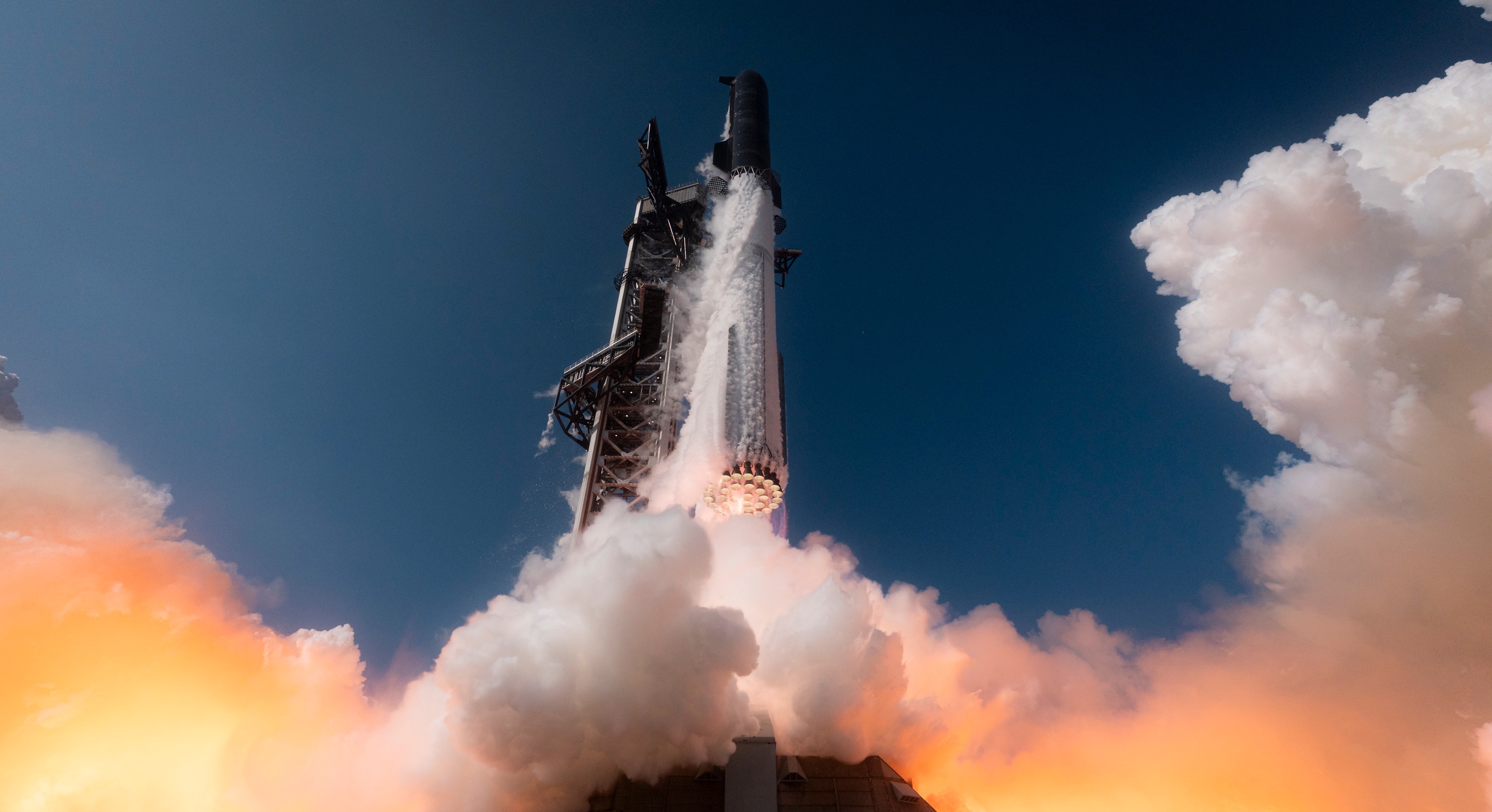

AMSTERDAM — The Federal Aviation Administration will require SpaceX to complete an investigation into its latest Starship test flight before allowing the vehicle to fly again.
In a May 27 statement, the FAA said it determined that the Flight 12 launch of Starship on May 22 from the company’s Starbase, Texas, facilities resulted in a mishap. The FAA defines a mishap as meeting one of several criteria, including the failure to complete a launch or reentry as planned.
The FAA said immediately after the launch it was investigating anomalies with the flight involving the Super Heavy booster, but had not yet determined whether the incident constituted a mishap as defined by the agency.
“After a thorough assessment of the operation, the FAA has determined the May 22 SpaceX Starship Flight 12 launch resulted in a mishap,” the FAA stated. “The mishap involved the Super Heavy booster as it flew back to the Gulf of America after stage separation.”
SpaceX intended to have Super Heavy perform a “boostback” burn after the Starship upper stage separated. The company did not plan to return the booster to the launch site to be caught by the launch tower, but instead perform a landing burn and “soft splashdown” in a region of the Gulf.
However, the booster appeared to suffer failures of several of its Raptor 3 engines shortly after starting the boostback burn. That maneuver, scheduled to last about one minute, ended after less than 20 seconds. The booster instead plummeted back to the Gulf, hitting the water at a speed of nearly 1,500 kilometers per hour, according to telemetry displayed during the SpaceX webcast of the launch.
The stage fell into a debris response area activated by the FAA, with no reports of damage. Several aircraft flights suffered departure delays or “airborne holding events” because of the Super Heavy anomaly, according to the FAA.
Because the FAA classified Flight 12 as a mishap, the agency will require SpaceX to conduct a mishap investigation that the FAA will oversee. That investigation is designed to determine the root cause of the incident and corrective actions. The FAA must approve SpaceX’s final report and corrective actions before allowing Starship to fly again.
While the FAA’s classification of Flight 12 as a mishap grounds Starship, in practice SpaceX would likely have conducted its own investigation into the incident and other issues with the launch before resuming Starship launches. That includes the early shutdown of one of the 33 Raptor engines on Super Heavy during its ascent and one of six engines on the upper stage.
Flight 12 was the first flight of version 3 of Starship, with numerous upgrades to both stages and the introduction of the Raptor 3 engines, which feature a simplified design and increased thrust. Despite the engine failure, SpaceX was able to complete many of its stated test objectives for the mission, including deployment of Starlink mass simulators while in space and a soft splashdown of the upper stage in its targeted landing zone in the Indian Ocean.
The mishap investigation will not necessarily be lengthy. The FAA declared a mishap on the most recent New Glenn launch on April 19 when the upper stage malfunctioned on its second burn, stranding its payload in a low, unrecoverable orbit. The FAA announced May 22 that it accepted Blue Origin’s investigation into the incident and would allow launches to resume.
Blue Origin announced May 27 that its next New Glenn launch will be the first for its largest commercial customer, Amazon Leo, carrying 48 satellites for the broadband constellation. That launch is planned for as soon as June 4, according to an FAA operations plan advisory.
Jeff Foust writes about space policy, commercial space, and related topics for SpaceNews.
He earned a Ph.D. in planetary sciences from the Massachusetts Institute of Technology and a bachelor’s degree with honors in geophysics and planetary science…
More by Jeff Foust
Read More
About The Author

